Things we're building to see if they work.
Live demos you can use, experiments in progress, and a public log of what shipped. Some of it turns into client work. Some of it just teaches us something, and that gets written up too.
Paper to data
Paste a messy document: a lease notice, an invoice, an email full of conditions. You get clean fields back, each with the exact words it came from, ready to drop into a system. Pick a sample or paste your own (leave out anything private).
Structured fields appear here, each with the exact words it came from.
On the bench.
 L-08LiveDeep Thought
Inspired by The Hitchhiker's Guide to the Galaxy, where the supercomputer Deep Thought spends 7.5 million years on the meaning of life and answers 42. Seven AI models from seven rival labs, anonymous in one group chat, had to agree 7 of 7 on the same question. Each one named itself and wrote the prompt for its own portrait. 828 messages, 24 votes, private huddles and one holdout, then they guessed who built whom. Edited down for drama, every line word for word.
What we learnedThe rule that mattered most: every no vote had to say what would change it, so each failed vote told the room what to fix. And the bots were bad at spotting each other: all six others pinned the holdout on the wrong lab.Read it → L-01LiveBlueprint
Describe a problem, get your workflow drafted with the weak spots marked. Two models, one rulebook, and code that does the arithmetic.
What we learnedLetting the model do the math was the fastest way to lose trust. Now it supplies counts and minutes; code does the rest.Try it → L-04LiveAI Mech Mayhem
A fight league where AI models pilot robot fighters. Sixteen fighters from eight AI labs, each flown by one of that lab's own models, from Claude and GPT to Gemini, Grok and Llama. Every beat both models pick a move in secret, the moves collide, and parts come off until one fighter is in pieces. Under each fight you can read what each model was thinking, beat by beat.
What we learnedWe started out tuning how well the models fought, but on screen an arm coming off was just a caption over two standing robots, and the camera never cut once. Turning each hit into a flurry of blows and cutting the pauses took a beat from 6 seconds to 3.7, and the hits on screen from 9 a minute to 35.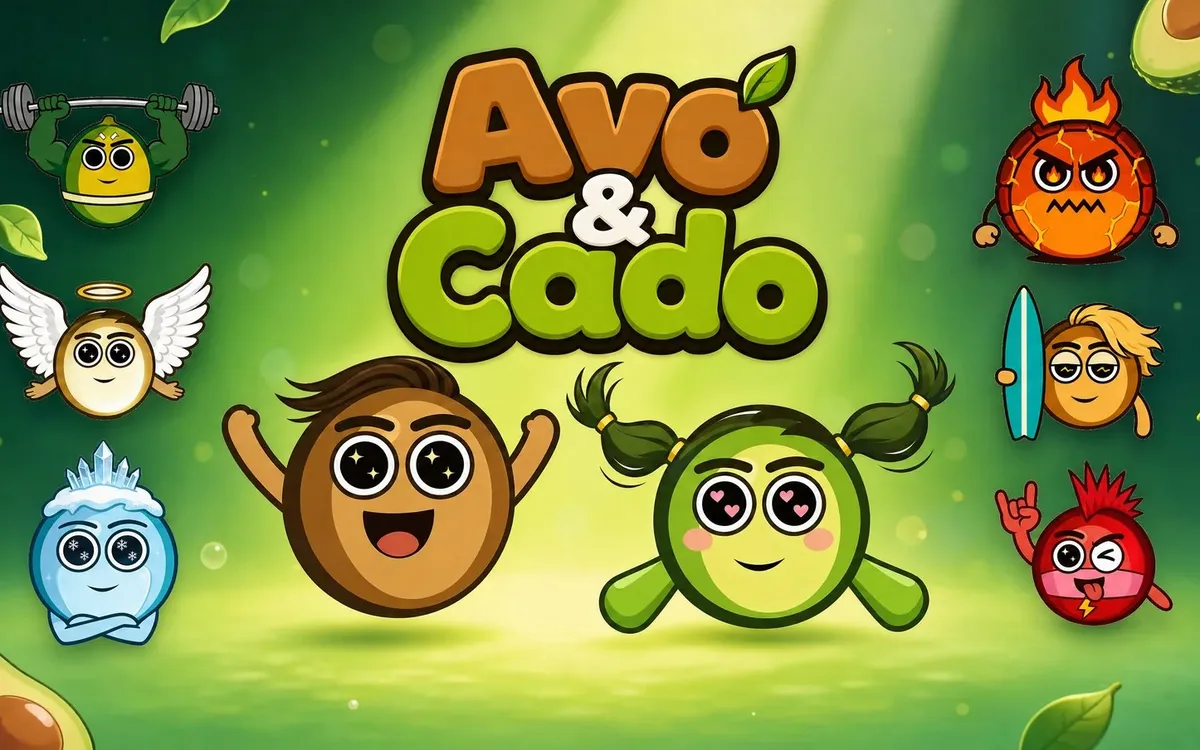 L-05LiveAvo & Cado
A tilt-controlled maze game for Apple Watch, built by Austin and his kids over a couple of weekends. Roll an avocado seed through 100 hand-designed mazes by tilting your wrist, with real ball physics, haptic bumps and eight unlockable characters the kids designed. No ads, no data collection, no in-app purchases.
What we learnedAn automated player that solves every level, using a model of human play, caught what playtesting missed: Easy and Normal were the same difficulty. We rebuilt the set from 82 to 100 levels with a real progression, calibrated on the kids' play times.Get it on the App Store →- L-02LivePaper to data
Paste a messy document and get clean fields back, each with the exact words it came from. Try it on this page.
What we learnedAsking for the source quote on every field cuts made-up values more than any instruction about accuracy. - L-06PrototypeZapdoodle
An iPhone app for kids 9 and up: describe a game or app in your own words and a working one appears on your phone in under a minute, saved as yours. No code. A quick classifier plans each request, then the model builds it on top of hand-tuned game engines.
What we learnedAutomated checks said the games worked. Playing them said otherwise: dinos floated over obstacles. Physics is a set of numbers a model can't reliably pick, so we locked the physics in hand-tuned engines and let the model write everything else. First-try success went from 67% to 92%, and each game got 40% cheaper. - L-07ShelvedINVENTOR
An invention-generation pipeline. Give it a technical problem and it combines mechanisms from unrelated fields into full invention write-ups, then runs each one through automated gates for feasibility, made-up facts, prior art and patent-examiner risk, scored against a local database of 733,000 patents. A person makes every keep-or-kill call. 290+ inventions reviewed across 95+ industries.
What we learnedAn independent web-search audit found real prior art the database scoring had missed, so we rebuilt that layer with full-text, global and academic search plus citation checks. Measuring every model swap mattered too: usable output went from about 20% on open-source models to about 95% on Claude Opus.
The prototype sprint.
Most of what's on this page started as a quick prototype. The sprint is the same thing pointed at your problem: a working version of one system, on your real data, for a fixed price. You find out if it's worth building before you pay to build it.
- Price
- Fixed, quoted up front
- Time
- Sized to the scope
- You get
- A working prototype, a demo with your team, and a written plan for the production build